Get regular updates from Minamata Convention
The 6 October session focused on key developments in the lead-up to the 17th meeting of the Conference of the Parties to the Convention on Biological Diversity (CBD COP 17).
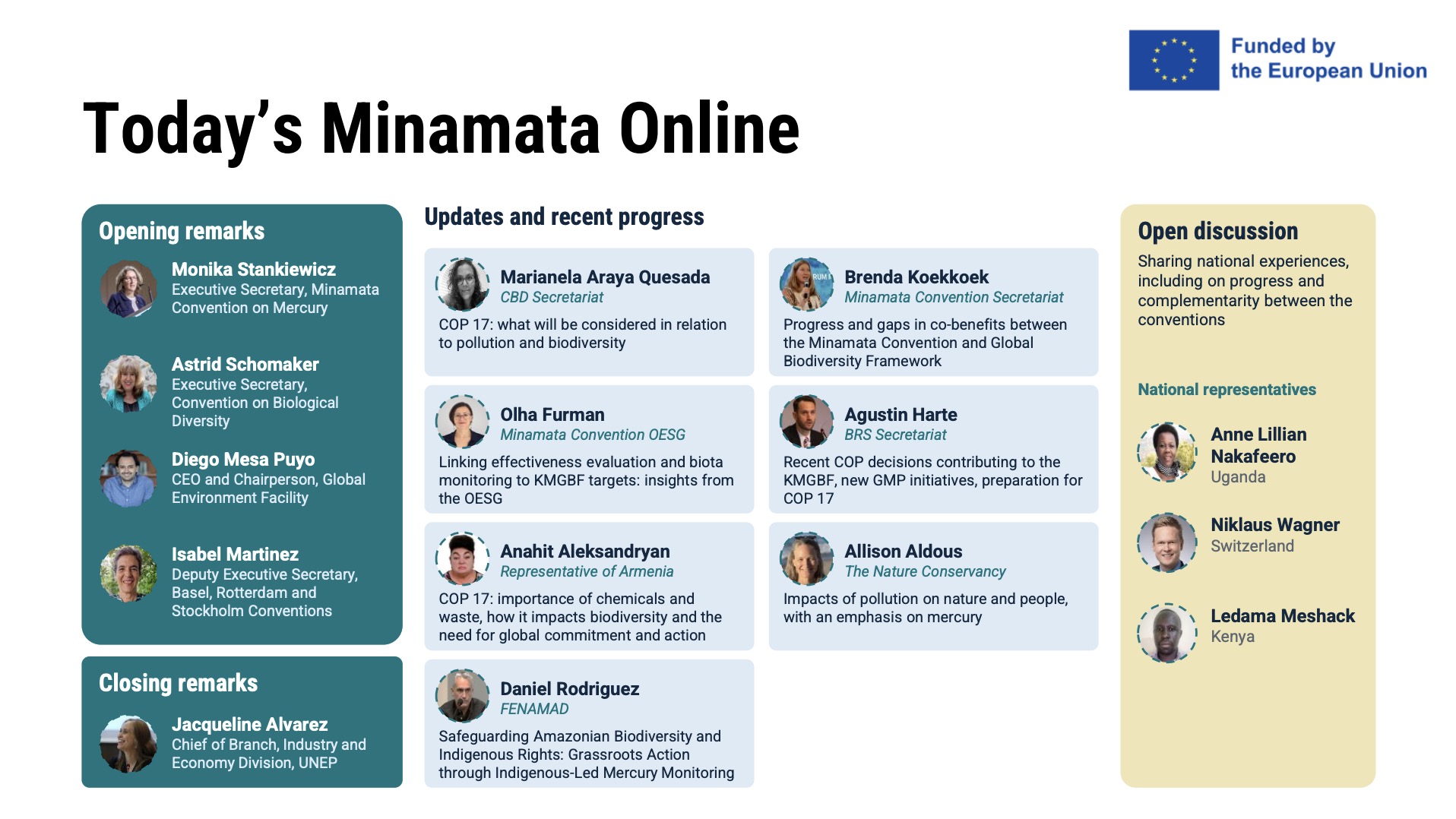
Held as part of the Minamata Online series, the webinar was jointly organized by the Secretariats of the Minamata Convention on Mercury, the Basel, Rotterdam and Stockholm (BRS) Conventions, and the Convention on Biological Diversity (CBD). The session, aimed at National Focal Points and government officials, covered updates from the CBD Secretariat on pollution and biodiversity ahead of CBD COP 17 and explored collaborative initiatives between multilateral environmental agreements (MEAs) on chemicals and waste and biodiversity contributing to the Kunming-Montreal Global Biodiversity Framework (KMGBF).
Opening the session, Monika Stankiewicz, Executive Secretary of the Minamata Convention on Mercury, stated: "The KMGBF provides an important avenue for collaboration. We need practical implementation with countries in the driving seat. In this regard, GEF-9 [the ninth replenishment of the Global Environment Facility] and its Integrated Programmes present an opportunity. I would welcome more projects that demonstrate how mercury pollution and biodiversity loss can be addressed simultaneously."
Astrid Schomaker, CBD Executive Secretary, pointed out: "We came together in 2024 to look at how the chemicals and waste conventions contributed to KMGBF, and now we continue this conversation. For us, it is important to acknowledge that pollution is not isolated from biodiversity; it is one of the five direct drivers of biodiversity loss. Therefore, we need each other because it is a collective effort."
Recalling that the GEF serves as the financial mechanism for biodiversity and chemicals conventions, Diego Mesa Puyo, CEO and Chairperson of the GEF, said: "GEF-9 gives us the opportunity to align implementation across conventions and reduce fragmentation.” He added: "Let’s include mercury and hazardous chemicals in national biodiversity strategies and biodiversity in mercury action plans."
Isabel Martinez, BRS Deputy Executive Secretary, stressed that activities under the KMGBF Target 7 on pollution are embedded in the work of the BRS Conventions and called on participants to identify one practical step to integrate chemicals and waste into biodiversity action plans.
Other panelists shared updates on progress under the conventions, monitoring initiatives and preparations for CBD COP 17, as well as perspectives on the impacts of chemicals, waste and pollution on biodiversity, nature and people, and Indigenous-led mercury monitoring. During the open discussion, national representatives from Uganda, Switzerland and Kenya shared experiences, including on progress and complementarity between the conventions.
The full presentations and video recording of the Minamata Online session are available on the event webpage.